Dozens of Mercy For Animals activists from all over the state converged at a hearing held at the Ohio Department of Agriculture to protest the proposed construction of Hi-Q Egg Farm – a six million hen factory farm slated for Central Ohio.
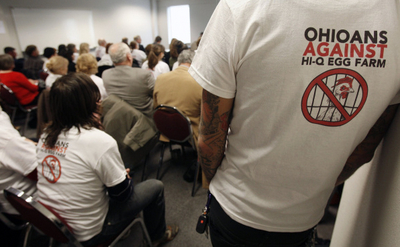
Although this was a public hearing, attendees were not permitted to make public comment. Gathering in solidarity, environmentalists, community members and individuals concerned about the welfare of animals boldly wore “Ohioans Against Hi-Q Egg Farm” t-shirts to stage a silent “stand in” inside the public hearing, urging the state to deny the factory farm permits needed to begin construction.
 Hi-Q Egg requested the hearing on construction permits relating to travel routes for the farm’s trucks. Hi-Q proposes to construct 15 egg-laying hen houses with 400,000 birds in each. If constructed, Hi-Q would be one of the largest egg-laying facilities in Ohio.
The millions of hens who could be confined at the proposed Hi-Q Egg Farm would be forced to live crammed together inside battery cages – small, barren wire cages stacked in rows inside filthy windowless sheds. Battery cages are typically the size of a file drawer and confine five to seven hens, giving each bird only 67 square inches of floor space – an area smaller than a notebook-sized piece of paper. Sickness and disease run rampant on factory farms when animals are forced to live in dirty and unsanitary conditions.
Protest against Hi-Q Egg Farms, LLC from F Tepper on Vimeo.
Numerous hidden-camera investigations conducted by Mercy For Animals at the nation’s largest battery-cage facilities have uncovered birds living in feces, dead hens left to rot in cages with birds still producing eggs for human consumption, birds suffering from untreated open wounds, infections and broken bones, and workers breaking birds’ necks, kicking hens and throwing live birds in trash bins.
In addition to cruelly confining six million hens, Hi-Q Egg Farm would reportedly produce at least 74,000 tons of chicken manure and 23 million gallons of manure-contaminated egg-wash water each year, creating an environmental and public food safety risk.
In an agreement reached earlier this year by Governor Ted Strickland and leaders of both the animal protection and farming communities, the Governor and Ohio Farm Bureau pledged to work to ensure that operating permits for Hi-Q are not granted – prohibiting the farm from beginning construction.
Hi-Q is bad for animals, the environment, neighboring communities and the state of Ohio. One of the best actions consumers can take to prevent animal cruelty and reduce the environmental and human health toll posed by factory farms is to adopt a healthy and compassionate vegan diet.