Normal
0
false
false
false
EN-CA
X-NONE
X-NONE
MicrosoftInternetExplorer4
Results from the most recent Canadian Cattlemen’s
Association’s National Beef Quality Audit conducted from 2009
to 2011 were announced in the June/July issue of Canadian Cattlemen magazine.
Audits were conducted three times prior: in 1995 to
determine a baseline; from 1998 to 1999; and in 2001. Statistics gathered
revealed a variety of “quality defects” in beef carcasses. These
defects provide a glimpse into the handling, health, and welfare of Canadian
cattle.
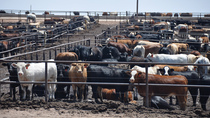
Slaughterhouses in both western and eastern Canada
participated in the latest audit. The plants surveyed are responsible for more
than 75 percent of the cattle killed in Canada, so the findings are
considered representative of the industry.
Three findings of the audit are particularly alarming, yet
received barely a passing mention in the magazine’s back-patting article:
1. The percentage of animals with liver abscesses was
significantly higher than in previous audits. In this most recent audit,
9.9 percent of cattle livers examined fell into the most extreme assessment
category (oddly called “A+”) of exhibiting one or more large, active
abscesses with inflammation of the liver tissue. In 1999, 2 percent of cattle
were affected to this extent.
2. The percentage of dark-cutting beef carcasses was
markedly higher. “Dark cutters” exhibit purplish-black flesh rather
than red. The condition has been linked to acute or chronic stress before
killing. Examples of such stress include transportation, rough handling, and
extended periods without food or water.
3. The percentage of “non-fed” animals (i.e.,
culled breeding beef and dairy cattle) with bruises was significantly higher. In
this latest audit, 85.7 percent of breeding cattle had bruises so large they
had to be cut out, an increase from the 76.4 percent discovered in 1999.
Bruising can result from rough handling, slamming gates, steep loading and
unloading ramps, overcrowding on livestock trucks, and poor driving en route to
the slaughterhouse.
Additionally, the audit notes that the increase in liver
abscesses is largely due to feeding grains to cattle, which is particularly
common on feedlots. According to TheBeefSite.com, grains
are difficult for cattle to digest and also lead to acidosis, which creates lesions in the stomach wall.
What this means to the animals themselves is that intestinal
gas is produced in quantities too high to pass. The accumulating gas puts
pressure on the animals’ diaphragms and lungs, making breathing difficult and
painful. Some animals develop rapidly swelling sides and show their suffering
by kicking at their sides or stomping their feet. Some of these animals die
from the condition (a survey by Agriculture and Agri-Food
Canada reported
that one-third of beef cattle deaths were caused by acidosis).
Feeding grains to cattle increases populations of the
bacteria Fusobacterium necrophorum as
well, leading to stomach wall abscesses, inflammation, and tissue death. This
bacteria travels to the liver via the bloodstream and causes abscesses.
The audit further states that these defects cost the beef
industry nearly $200 million annually, yet profit gains from current animal
handling practices outweigh the losses. True to industry form, the focus is on
consumer satisfaction and its own bottom line, with little to no regard for the
suffering of the animals themselves.
You can let Canada’s
beef producers know that you don’t support their cruel practices by adopting a
compassionate plant-based diet. Go to ChooseVeg.ca
to learn how.
st1:*{behavior:url(#ieooui) }
/* Style Definitions */
table.MsoNormalTable
{mso-style-name:”Table Normal”;
mso-tstyle-rowband-size:0;
mso-tstyle-colband-size:0;
mso-style-noshow:yes;
mso-style-priority:99;
mso-style-qformat:yes;
mso-style-parent:””;
mso-padding-alt:0cm 5.4pt 0cm 5.4pt;
mso-para-margin:0cm;
mso-para-margin-bottom:.0001pt;
mso-pagination:widow-orphan;
font-size:11.0pt;
font-family:”Calibri”,”sans-serif”;
mso-ascii-font-family:Calibri;
mso-ascii-theme-font:minor-latin;
mso-fareast-font-family:”Times New Roman”;
mso-fareast-theme-font:minor-fareast;
mso-hansi-font-family:Calibri;
mso-hansi-theme-font:minor-latin;
mso-bidi-font-family:”Times New Roman”;
mso-bidi-theme-font:minor-bidi;}