Normal
0
false
false
false
EN-CA
X-NONE
X-NONE
MicrosoftInternetExplorer4
The National Farm Animal Care Council
(NFACC), a livestock commodity-driven organization, recently released its Revised
Code of Practice for the Care and Handling of Pigs.
Set to replace the original code developed twenty years ago, the revised code
was developed by a seventeen-member committee representing pig producers,
transporters, processors, government, academia, and one representative from the
Canadian Federation for Humane Societies.
While such codes are recommended and
voluntary, some provincial courts have recognized them as forming the basis for
the definition of “standard practice.”
The revised code has significant room
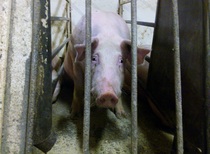
for improvement, but does recognize the inherent cruelty of gestation crates
and mutilations without painkillers—two
abuses exposed by our undercover
investigation at a Manitoba
pig-breeding facility last December.
The Good
Gestation Crates
The draft code
recognizes that sows confined to gestation crates show an increased incidence
of stress behaviours, such as bar-biting and sham-chewing, and calls for an end
to the permanent immobilization of sows.
·
As
of July 1, 2014, all newly built or rebuilt barns must house sows in groups.
All other facilities must house sows in groups as of July 1, 2024.
The Bad
Gestation Crates
·
No
rationale is provided for the phase out date of 2024. The country’s largest
pork-producing corporations, retailers, and fast-food companies have committed
to phase-out dates ranging from 2017 to 2022. The phase out date should reflect
this timeline and be completed by 2022 at the latest.
·
The
code continues to allow for some crated confinement. Sows may be confined for five
weeks at a time – adding up to more than nine months of confinement during the
sows’ four-year lives.
Mutilations
·
Although castration is completely unnecessary and
has in fact been banned by the EU (effective 2018; 2015 in The Netherlands; and
already almost completely phased out in the UK), the draft code continues to
allow the painful practice.
But you can help change this. NFACC’s draft is up for public
review until August 3, and pigs need you to speak up for them. Here’s how:
Step 1: Click here to go to
NFACC’s website.
Step 2:
Select the red square titled “Click here to participate in the pig code of
practice public comment period.”
Step 3:
Fill out the survey. While the entire survey is lengthy and covers many issues,
you can save time if you just want to focus on the issue of pig confinement by
selecting “No comments on this section” for most of the sections.
When you get to section 1.1.3, please
write in the “Comments” section that you don’t support allowing
producers to confine pigs inside cages so small they can’t even turn around for
any length of time and that the phase
out should be completed by 2022 at the latest.
Also, please write in section 4.5.1 that you believe that castration should be completely banned. This should take you
just two minutes.
Of course, the most powerful action you
can take on behalf of pigs—and
all farmed animals—is to move to a plant-based diet. For tips, recipes,
and more, go to ChooseVeg.ca.
st1:*{behavior:url(#ieooui) }
/* Style Definitions */
table.MsoNormalTable
{mso-style-name:”Table Normal”;
mso-tstyle-rowband-size:0;
mso-tstyle-colband-size:0;
mso-style-noshow:yes;
mso-style-priority:99;
mso-style-qformat:yes;
mso-style-parent:””;
mso-padding-alt:0cm 5.4pt 0cm 5.4pt;
mso-para-margin:0cm;
mso-para-margin-bottom:.0001pt;
mso-pagination:widow-orphan;
font-size:10.0pt;
font-family:”Times New Roman”,”serif”;}