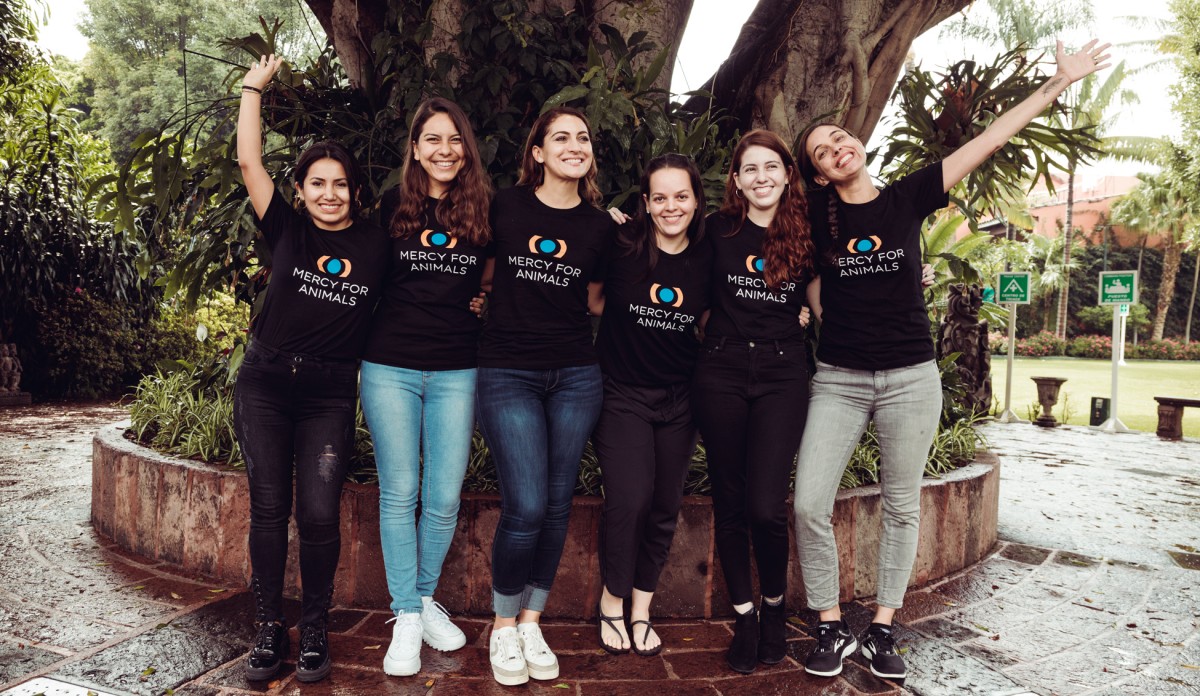
Badass women are leading the charge against animal exploitation. In fact, membership in animal protection groups is 75 percent women!
Data shows that women are more likely to be against animal experimentation, more likely to have companion animals, and less likely to abuse animals. Feminism has actually been linked to animal protection since the 1940s, when two prominent women’s suffrage campaigners lobbied the United Nations to give animals formal rights.
But why is this? Why are women such staunch defenders of the nonhumans who share this earth with us? For years, psychologists have ruminated on this exact question, and they have come up with some interesting theories.
Two years ago, psychologist Carolyn Semmler decided to tackle the “meat paradox”—the strange phenomenon of humans claiming to love animals and yet eating them. She teamed up with colleagues from the University of Adelaide to conduct a study. Participants in two groups of 230 were each asked to select a lamb dish. Next, participants in one group received just the nutritional profiles of their dishes, while the others listened to how the lambs were raised and slaughtered.
The groups then completed a survey that measured changes in their perceptions of the lamb dishes. Women felt worse after hearing about the connection between the dish and the animals killed for it, while men were less affected.
Many men even seemed to grow defensive. “There was a group of male participants who had a really strong reaction to the study—saying that they were going to eat more meat, because they thought we wanted them to eat less,” Semmler said. One man explained that “based on the line of questioning in this survey,” he feared efforts were underway “to ban meat.” He added, “I had better enjoy as much as possible while I am able.”
Clearly women deal with the meat paradox very differently than men. A study conducted by Hank Rothgerber from Bellarmine University in Kentucky found that women were more likely to avoid connecting meat with animals to escape the paradox. On the other hand, men often dealt with the paradox by claiming that animals cannot feel pain, that animals are meant to be eaten, and that humans can treat animals however they wish.
Semmler summed up the different ways men and women face the meat paradox:
While men tend to go on the attack, women tend to think “I’m going to modify my behaviour because the problem is with me—I’m going to accept responsibility for this.”
Another theory, known as the social dominance theory, suggests that eating meat reinforces men’s feelings of dominance. By eating animals, they are asserting their power over other living beings.
In the 1980s, anthropologist Peggy Sanday conducted a study on the power structures of two different types of hunter-gatherer cultures. Her results showed that cultures more heavily dependent on meat were more patriarchal, while cultures less dependent on it were more egalitarian.
Plant-based eating is gaining popularity with both men and women. In fact, there were six times as many vegans in the United States in 2017 as in 2014! But women are leading the charge.
Fight back against the dreaded meat paradox by adding more plant-based foods to your daily routine. Get delicious recipes and simple meal ideas at chooseveg.com!